Saturday, November 04, 2017

Orbital views...

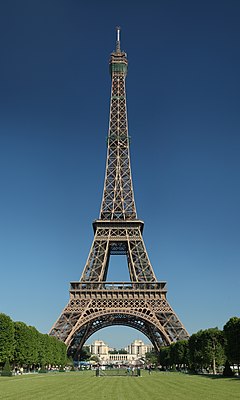
I lived in London for a few months in 2011 and had the opportunity to see the Orbit being constructed at the Olympic Village. To me it looked like a twisted radio tower, and reading about it I realised that it was supposed to be a "sculpture" by the renowned artist Anish Kapoor. Many Londoners were criticising the Orbit being an eyesore, and a waste of money (20 million pounds funded by Laxmi Mittal). But the creators' justification was that people said the same about Eiffel tower when it was being built, and that it takes time to appreciate the beauty of a creation. A few months later, I visited Paris and while looking at the Eiffel, I couldn't find any reason why the Orbit should be in the same ball park!
Tour Eiffel Wikimedia Commons (cropped).jpg

I saw a couple of other installations by Sir Anish Kapoor in the following years - The Bean in Chigaco, and The Sky Mirror exhibited in Sydney. 

A large, highly-polished, mirrored bean-shaped sculpture seen from the east, reflecting the skyscrapers to the north along East Randolph Street (The Heritage, Smurfit-Stone Building, Two Prudential Plaza, One Prudential Plaza, and Aon Center.

Both these were far more appealing to me than the Orbit, for obvious reasons. Reading up, I realised that these were created in the early 2000s, much before the Orbit. Would that be a reason for its appeal - that enough time has passed and our sensibilities have changed? 

I remember a scene in the movie The Fight Club where a corporate art installation is destroyed by the "club members. I am very sure that majority of the viewers chuckled at this sight, thinking "Yeah, we never got it, anyway!" I definitely did.


If you have been to Melbourne, one thing that strikes you immediately on the drive from the airport to the city is the number of modern art installations. It is a bit overwhelming, it was for me at least. Is it because these are too abstract? Or is it that the engineering marvel that these constructions are overrides the creativity or aesthetics behind it? Is construction art?

(to continue)

Saturday, June 24, 2017

But, one band...

Taking cue from a facebook post by film maker Jaideep Varma, I watched his 4th full length documentary “Par Ek Din” today. With a foot note specifying that it was shot in about 4 days under a budget of 1 lakh rupees, and about a band that has not released any music so far – you pretty much know what to expect.  But having watched all his previous films, I couldn’t wait any longer.

15 minutes into the film, I felt the same enthusiasm as watching a “Classic albums” documentary, which had a more generous production backing. I had watched a couple of these, and the documentary on Steely Dan’s Aja is exceptionally filmed. But then, a realisation struck me – the making of music that I had watched on Classic albums series were of albums that I had listened to at least a thousand times before I watched the documentary, which made that watching extremely engrossing. However, Par Ek Din was about a band I had not even heard before, and the music was all new to me. Still, I was hooked till the final cut!

Par Ek Din covers the story and music of the band CityHaze based in Mumbai, members with an average age of 25. From the first song featured, you know that you are in for a different sound, and utterly fresh and beautiful, but rather “gloomy”, lyrics. I wouldn’t say that the sound of the band is completely original or fresh. While I was debating this in my mind, my wife who heard one of the songs asked me whether they were covering Wilco, which pretty much made me conclude that they did not have a very original sound, but then again I was thinking about the definition of originality. You could see a lot of influences, especially that of Lucky Ali which is mentioned in the movie, and through a poster in their bed room – but the way the whole thing came together, there was magic! I felt better when I remembered something that I had read in the liner notes of an Amit Chaudhuri album, written by Prof Anand Lal:
To tell the truth, all music is fusion. No musical form remains untouched by acculturation, though classical pundits still turn up their noses at the perjury committed by colleagues who jam with jazzmen. To pin those purists down on hybridization, just ask them how their ragas Kafi or Miyan ki Malhar got their names, or how violin found such a hallowed place in south India.
Hence, I find it absurd to classify a particular artist into a specific genre, or to judge the originality of the sound – it is just the working of various things that goes into music making that defines what it really is.

One key element that stands out in the film is the band’s honesty. I was very impressed by their view points, and seriously doubt whether I had that much of worldview when I was 25! Speaking of honesty, they were not shy to tell you about their shared interest in watching WWF wrestling! I remembered with a smile what Frederick, a serious painter from Woody Allen’s Hannah and Her Sisters, said:"Can you imagine the level of a mind that watches wrestling?" 

It was really heartening to see these five individuals striking a path to their calling, than be forced to comply with the society’s rules – perhaps a message that this film delivers apart from the sheer joy of watching music making.

Watch Par Ek Din here:

Sunday, April 23, 2017

The Big Picture view

Second post in Notes from the Key of Life
The procession to Cavalry by Pieter Bruegel (1564)

The brilliant 3 part TV programme Stargazing Live (Australia) was broadcast on ABC a few weeks ago. Dr. Brian Cox opened the show by quoting Carl Sagan, reminding us how astronomy can be a humbling and  character-building experience. Carl Sagan wrote in his book A Pale Blue Dot:
There is perhaps no better demonstration of the folly of human conceits than this distant image of our tiny world. To me, it underscores our responsibility to deal more kindly with one another, and to preserve and cherish the pale blue dot, the only home we've ever known.

It took almost 17 years of my existence to realise this. I was finishing my senior secondary school and subjected to immense pressure to perform academically in an admission test for professional courses at the university. One night I happened to look at the sky and had shivers up my spine when I thought about the vastness of the universe and the origin of life on earth. And then on evolution and how mankind has created countries, societies, and economy -  which pretty much drives everything that we do in our daily lives - including the admission test. This big picture view, as Sagan said, was a humbling experience, and did put me at ease, at least to some extent. 

I got my first job when I was 22, and the IT company I joined was trying to focus more on Quality Control in their processes, at that time. We were sent for a day training on Six Sigma process, a path breaking methodology that helped minimise defects. The trainer started with an anecdote soon after he introduced the methodology. I don't remember much of the details, but it went something like this:
A pet food company in the UK decided to focus immensely on the quality control of their pet food manufacturing process, with a vision to become the market leader. Huge investment was made and leading process frameworks and methodologies were applied. Improvement in the quality of the product was measured and it aligned with the company's objective. However, to much surprise, the company went bust within few months. A leading business school investigated the cause and published a case study. The reason for the pet food company's failure, though it had excellent quality controls and favourable market conditions, was quite simple: dogs did not like the food.

That said, apropos of nothing, I leave you to admire Bruegel's The Procession to Cavalry.

Sunday, March 26, 2017

Mah, Who am I to judge?


Last year while visiting family, in a casual conversation with my brother, a topic came up regarding the principles that we live by. I had not thought much about it in a way I could articulate it. I remember mentioning a couple - one about relationships and another one on integrity. The more I thought about it, and with some of the recent experiences in my life, I had a desire to write them down, so that I could get others' views on these. Again, I did not want to make any motherhood statements, or be preachy, but wanted to write them down casually with anecdotes that people could relate to. Here is the first one:

               *                                                 *                                          *

Notes from the Key of Life: "Mah, Who am I to Judge?"

In the early days of blogs, I followed Scott Adams, and there was this one blog post from 2007 that left a lasting impression on me. In this post Adams tells us that sometimes to test his point of view on a particular subject, he would take the opposite side and try to defend it. He illustrates this by making his point as to why it was a good idea for US to attack Iraq – whereas common sense told us that the Iraq invasion was a blunder.

It showed me how 180 degree thinking can enrich your point of view, and I tried to incorporate this in my professional life. In the early noughties, Times of India had a similar column on the edit page - not sure whether they still do this – where Times’ view and a counter view of a specific news item was given side by side. It was very interesting to see different points of view in one go. But at times, the counter view was so laboured that you could say that it was being done for the sake of it. But by and large it was a good exercise, along the lines of what Scott Adams did.

Over the last few years, I have tried to incorporate this into my personal life as well, especially when you don’t agree with someone’s point of view and the situation can eventually end in an argument or being sour. In such scenarios it is more like “putting yourself in the other person’s shoes” view, which would help us calm down very quickly and focus on the bigger picture.


Many people consider Pope Francis’ stance on homosexuality as a defining moment in the history of Catholic Church, when in an impromptu press conference Pope made this remark about gays: “Who am I to judge?” It actually did not change any of Church’s stances against homosexuality, but it was the gesture that mattered the most. I had already framed my point of view on homosexuality much before this remark from the Pope (I support LGBTI, but not same-sex parenthood), but it gave me a whole new perspective on humility. I thought about this further after reading a cover story on Pope Francis where Mark Binelli sheds more light into Pope’s now famous remark. In that press conference there was a lead up conversation, and it was in the context of individual gay people who are well-intentioned and seeking God, that the Pope remarked “Who am I to judge?”  Apparently, what he actually said was “Mah, Who am I to judge?” Binelli writes:
In Italian, mah is an interjection with no exact English parallel, sort of the verbal equivalent of an emphatic shrug. My dad's use of mah most often precedes his resignedly pouring another splash of grappa into his coffee. The closest translation I can come up with is "Look, who the hell knows?
Who the hell knows? What if I am wrong? Such an admission that even a person like the Pope is not infallible inspired me to put a similar lens on my views, even though at times I might be absolutely certain that I am right.


In Return: Just a Book is a 2016 documentary based on the bestselling Malayalam novel Oru Sankeerthanam Pole (Like a Psalm), which is a fictitious account of the life of Fyodor Dostoevsky and his relationship with his stenographer Anna. I read a review of this documentary in a magazine, which had some quotes from the book. I haven’t read the book or watched the documentary, however one of the quotes rang a bell with a situation I was dealing with in my personal life. It roughly translates like this: Before you judge a person, have you heard his story, or know what he has been through?


I have been judgemental, and also been subjected to harsh judgement by others. Whatever I have quoted above, and whatever I discover as I go, helps me in addressing such situations with much clarity, most of the time.

However, I can’t sign off without providing a counter-view! There is a risk that your inability to influence change could well be comforted by “what if I am wrong” excuse and inaction. At the end of the day, these are just guidelines and you apply them contextually and with common sense.

Sunday, December 22, 2013

Holiday Reading

I haven't referred to any lists for my holiday reading this time around. I have started with Cormac McCarthy's The Road. Not a pleasant start. The movie itself was so terrifying. I don't really chase and watch any of those "horror movies", but The Road disturbed me more than any movie I had seen. Perhaps, as Sherlock Holmes said, you feel horror when a situation kindles your imagination. In A Study in Scarlet, when Watson was upset by one murder, he who has seen so many in the battlefields, Holmes says:
 “I can understand. There is a mystery about this which stimulates the imagination; where there is no imagination there is no horror.”
I wonder how I would have felt reading The Road, if I had not seen the movie. McCarthy is a brilliant writer. I was tempted to read McCarthy because of the late Roger Ebert. In many of his reviews and blog posts he talked about McCarthy which made me curious. Read his post Perform a concert in words where he talks about how McCarthy's Suttree influenced him. Perhaps this blog post of his might turn out to be my holiday reading list!

I have also started reading Neil Young's autobiography (or let's say, journal) Waging Heavy Peace, which is the reason for posting this. In fact, I am also listening to his latest album Psychedelic Pill side by side. The album works well as a companion CD to the book. In the book, Young writes a lot about his passions which have turned into entrepreneurial initiatives, like the studio quality music player Pono and his hybrid car engines.  In the album opener "Driftin' back" which runs for 27 minutes, he expresses the same sentiments ("I don't want my mp3"). Young is not trying to be a great literary writer with this book, he has written the passages very casually - you can find the word "cool" every now and then -  which is interesting, as he is an amazing song writer (But me I'm not stopping there/Got my own row left to hoe/Just another line in the field of time - from Thrasher).

Neil Young's father was a writer. When he was a child, his father told him "Just write every day, and you will be surprised what comes out". I am following that advice too. Hence this post.


H/T: E's flat blog for the Holmes anecdote.

Friday, October 18, 2013

The lost art of buying albums...


The Civil Wars's new  self titled LP 
Michael Kiwanuka - Home again (our current favourite)
Leonard Cohen - Old ideas (CD was ridiculously cheap compared to Vinyl)
Mumford and sons - Babel (the wife's choice)
Tedeschi Trucks band - Revelator +live 2CDs
The Civil Wars - Barton Hollow Deluxe edition (my favorite album of 2012)

Friday, July 19, 2013

Into my head!

Author Graham Greene's name registered in my mind when I read obituaries of RK Narayan while I was in college. My room-mate had a subscription to Frontline magazine, and they extensively covered Narayan's life and works in that issue, including a piece by N. Ram, and how Graham Greene 'discovered' Narayan.

I am a great fan of Pico Iyer's writing, having read two of his books and many articles. Also, a bit jealous of the life he leads - he still doesn't carry a mobile phone, I can't go that far but have made up my mind on not possessing  a smart phone - spends his time between Kyoto and a monastery in the west coast of US, is a friend of and have interviewed Leonard Cohen, wrote a great travel book and found a wife in the process, as someone remarked (The lady and the monk) - what more can you ask for!

Anyhow, on reading about the release of his last book - The Man within My Head, subtitled "Graham Greene, My Father and Me", I wanted to read at least a couple of  Graham Greene books. The reviews of Iyer's book stated that you really don't have to be a Greene reader to enjoy this book, as the book is more on Iyer's personal life, his relationship with his father, etc. However, I thought that I would enjoy the book more if I had some background to Greene's writing. Hence here I am with a target of finishing 3 Greene books at least - The Quiet American to start with. I am half way into the book and I am really glad that I chose to read Greene! And I can't believe that it was written in 1955!

Two random quotes from The Quiet American:
I shut my eyes and she was again the same as she used to be: she was the hiss of steam, the clink of a cup, she was a certain hour of the night and the promise of rest.
‘I’m not involved. Not involved,’ I repeated. It had been an article of my creed. The human condition being what it was, let them fight, let them love, let them murder, I would not be involved. My fellow journalists call themselves correspondents; I preferred the title of reporter. I wrote what I saw. I took no action – even an opinion is a kind of action.

Monday, January 28, 2013

Moonrise Kingdom


January issue of The Atlantic has profiled the Pythons - The Beatles of Comedy by David Free (Free is an Australian!)
Free mentions:

I concede that there are people who don’t find the parrot sketch funny at all. I know a couple of them personally. They are unmoved by the sight of John Cleese in his raincoat, wielding that stuffed parrot and saying, “It’s bleeding demised.” I know them, but I can’t help them.

Exactly my sentiments after  I watched Wes Anderson's Moonrise Kingdom - not the comedy per se, but the whole movie as such. Its classic Wes, with classic Wes moments and a classy cast.

Saturday, December 15, 2012

A song that has no end...


I haven't listened to any new releases from Bonnie "Prince" Billy (Will Oldham) for almost a year now and decided to Google on what's he up to these days.  Prolific musician that he is, it is impossible to keep up with him. There’s loads of amazing new stuff (can’t resist– amazing new SHIT!!) he has done in the last year or so.

To start with, I was stunned by his new version of “I see a darkness” on his new EP (of his own covers – Now here’s my plan [Jul 2012])

Accompanying the EP is a new book of interview: Will Oldham on Bonnie “Prince” Billy (just made a ‘recommendation’ to my local library).

 Among various other things (bunch of albums – allmusic lists three in 2012, a new perfume brand - Eau de Will Oldham, a coffee bean line[2011] etc.), for Record store day 2012 he released a special condom, to carry your most precious limited-edition Record Store Day "release”.
 
Phew. Also added to my DVD rental queue – This must be the place [2011] starring Sean Penn and Frances McDormand. Will Oldham worked with David Byrne of the Talking Heads for soundtrack and score for this movie (called themselves as The Pieces of Shit), which tells a story of an aging goth rock star.


Perhaps that’s enough for 2012.
Update 07/13: This must be the place is an awesome movie!!

Saturday, March 12, 2011

ON AIR

In 127 hours, there is a brilliant scene in which James Franco enacts a radio show, including a phone-in. It’s done exceptionally well by Franco and is my favourite scene in the movie. But, thinking about it, it would have been easy for Simon Beaufoy and Danny Boyle to write that scene (in case it is not from the book the script is adapted from); because you have heard it many times on the radio, and that is the format all radio stations across the globe follow. Very few radio stations try to be different, at least in the music they play. BBC 6 Music, which plays non-mainstream music, is one such station, and much debate has happened on its planned closure (at least put on hold, as of now) - give it a listen on the BBC iplayer.


Reason for posting this – I just finished reading stand-up comedian and Radio DJ Phill Jupitus’s excellent book “Good Morning Nantwich: Adventures in breakfast radio”, an account of his days at 6 Music, hosting the breakfast show. This is perhaps the first book I have come across which celebrates the love for radio (Woody Allen’s Radio Days is an attempt in film). If you are a radio- junkie and loves music, get hold of this book! It narrates what happens in a radio studio and ultimately tells you why Phil quit 6 Music, when the station management wanted him to stick to the station playlist (of course, he must quit in such a situation, what else you can expect from the maverick DJ of an indie music station!) The book also contains a section on how to start your own radio show on the internet. The book could have been edited to make it tighter, even so it was a pleasure reading it.

Since I mentioned the movie 127 hours, it was great listening to Bill Withers’s fabulous song Lovely Day, in the movie. It was something like what radio does - surprise you with a song that you loved, but have forgotten.

Wednesday, February 16, 2011

Too young to be Grammy material

I was not aware of this "trivia" - it was Neil Young's first Grammy (for music), last Sunday. Not that I care much about the Grammys. But this is really laughable. Have read that Dylan also received one pretty late... for Modern Times? Not sure, and no - I’m not reaching for the Google button.

Tuesday, February 15, 2011

Biz piece

On my way to work today, I was reading this free business newspaper (ah, the free tube newspapers, one of the few joys of working in London, and get to know who threw their cat in the garbage) and actually smiled reading this column on Nokia's burning state:
NOKIA finally confirmed a tie-up with Microsoft on Friday, which sent a ripple of excitement through absolutely nobody. At Mobile World Congress (MWC) this week it will announce a new tablet. Or an Xbox phone. Or a giant laser with which it will attempt to destroy the moon. It doesn’t really mater – nobody will pay any attention anyway.


[...] The problem is, Nokia is both vast and dull. It’s like Canada. Its phones are about as exciting as the vast swathes of icy tundra; characterless and difficult to navigate.
Sure, they both have their highlights. Canada has Montreal. The camera on Nokia’s N8 is nice. But this doesn’t make up for the N900. Or Celine Dion.

Tuesday, February 08, 2011

Maugham

Picked up a Somerset Maugham novel after a gap of almost 5 years! Perhaps he induced in me whatever cynicism I possess, through his three famous books - Of Human Bondage, The Moon and Six Pence and The Razor’s Edge.

The book I started reading now, Cakes and Ale, another classic, is his take on the literary world. The first few pages itself put me back in the somewhat strange and, in fact, likeable world of Maugham.
For instance, the way he details the appearance of his characters:
...a fine, upstanding young man, six feet high in his stockinged feet and of an athletic build, with broad shoulders and a confident carriage. He was not handsome, but in a manly way agreeable to look at, with wide, blue, frank eyes and curly hair of a lightish brown; his nose was rather short and broad, his chin square. He looked honest, clean and healthy. He was something of an athlete.
Or his typical observations of human nature:
Hypocrisy is the most difficult and nerve-racking vice that any man can pursue; it needs an unceasing vigilance and a rare detachment of spirit. It cannot, like adultery or gluttony, be practised at spare moments; it is a whole-time job.
Happy to be reading Maugham again!

Monday, February 07, 2011

Bruce Springsteen - The Collection

This is simply the best thing money can buy at the moment! First 7 studio albums of Bruce Springsteen in a box set for less than Rs. 1000. Just placed an order, though I already have 3 of these albums (Nebraska on CD, Born to Run and Darkness on tapes.)

I often dislike the fact that many of our rock idols mature as they progress in their career, and seek out something more rewarding for them, musically, than create the same music which made them popular; many drift towards jazz or world music – like Sting, Paul Simon or Joni Mitchell.

While listening to Springsteen’s 2009 release Working on a Dream, I was struck by the realization that Springsteen is doing just the reverse. Compare his first two albums and the last two, and you’ll know why. His debut Greetings from Asbury Park, NJ and the next one The Wild, the Innocent, and the E street shuffle are more mature, jazzy and elaborate than his latest two releases, Magic and Working on a Dream which, in Springsteen’s words itself, is “pop sound”. Interesting. But I don’t mind, as long as he continues to recreate Magic.

Wednesday, February 02, 2011

The Limits of Control

Thoroughly disappointed by Jim Jarmusch’s highly indulgent “The Limits of Control”. The movie, in fact, tested my limits of tolerance. But the 2 hours spent was worth just for this one scene- 3 minutes of an amazing flamenco performance:
Watch it!

He who thinks that he’s bigger than the rest
Must go to the cemetery
There he will see, what the world really is:
It’s a handful of dirt.

Sunday, January 30, 2011

The curious case of critics

The other day, film critic Rajeev Masand tweeted that there is no God if James Franco was not nominated in the Best actor category at the Oscars. In the review that followed, he raves about the movie and there is not a single negative point he has cited. And he gives it 4 out of 5 stars.
He writes:
The extraordinary cinematography by Anthony Dod Mantle and Enrique Chediak, and AR Rahman’s haunting score complement Boyle’s rich and imaginative storytelling style. And James Franco who appears in more or less every scene delivers a performance nothing short of spellbinding.
Question: Can someone please enlighten me on why he refrained from giving it 5 out of 5 if, in his opinion, the movie scores full marks in all aspects?

I have watched some reality shows on Indian television where one of the judges marks a performance 21 out of 25, while the other one marks it 23/25, without any explanation on how this score was arrived at!

The wonderful guys at the fabulous Sound Opinions, rates a record as buy it, burn it, or trash it. When I heard it the first time, I didn’t get what “burn it” meant, and on reading up:
Burn it! ...There are a few good tracks here, but not worth the full price....try a downloading service, or (cough), another method.
This is kind of, I would say, innovative and "adapting to the times".

Maybe, someday, all critics would follow a thumb rule, like Siskel and Ebert did – Up or Down? Which is it?
Gene Siskel boiled it down: "What's the first thing people ask you? Should I see this movie? They don't want a speech on the director's career. Thumbs up--yes. Thumbs down--no."
PS: I attended a session by Rajeev Masand in Bangalore in 2010 and found him to be genuine. When my brother asked him what he thinks about The Big Lebowski, he more or less admitted that he didn’t get it the first time and that he is planning to watch it again. That was an honest response!

Saturday, November 20, 2010

études


BBC had aired Leonard Cohen's Live in London concert (2008-09) some weeks back and I had a great time watching him perform – especially the fantastic opening song "Lover Lover Lover" (video from the Bratislava concert of the same tour here). Some time before this, I had picked up his book, Death of a lady's man, a collection of poetry and prose. But I just couldn't read beyond 7-8 pieces. I don't think his poems as such will work for me as much as they do when set to music. For the record, I don't listen to Cohen just for the words. I love the tunes and of course, his singing.

While on the topic of words, prose, poetry etc., I must mention that I absolutely enjoyed reading Aseem Kaul's études, a collection of (very) short fiction, much like the author's blog posts. I am not sure whether the contents of the book were previously published on his blog, though the formats of some stories are strikingly similar. There are some cheesy pieces here and there, but by and large it is full of imaginative, metaphorical, stunning poetic gems. In fact, this book worked for me better than Cohen's.
Read the Mint review here.

Sunday, April 25, 2010

A Boy named "Sue"

I wonder why a male singer would cover a song which has a female protagonist in first person, and vice versa. In some cases they adjust the lyrics to take care of the gender references – like changing “I’m your lady” to “you’re my lady” (Power of love, not sure which one is the original) etc.

Two brilliant covers I heard recently that doesn't take the pain (well, it’s not possible in these cases) to do a "gender flip":

Rosanne Cash – Long black veil (a live version here)

The White stripes– Jolene (Jack White sings Jolene Jolene.. pls don’t take my man, heh! Heard it on Sound Opinions)

Wednesday, April 21, 2010

The same old tune

“Genius borrows nobly. Art is theft. Good poets borrow; great poets steal. James Joyce said, “I am quite content to go down to posterity as a scissors-and-paste man.” Who owns the words? We all do, though not all of us know it yet. Art is not a patent office. It’s a conversation between and among artists.”

That was David Shields, in the introduction to his post on NYT’s Living with music blog series. I don’t agree with him on this, as you know there is so much art out there which is absolutely original... like...er, I don’t know. His playlist, however, is very interesting – a list of recyled/sampled music.

Tuesday, March 09, 2010